llllllllllllllllllll wrote: Tue Nov 25, 2025 5:22 pm
Also, to clarify, when checking phase w/ the scope, the A is note was almost perfect and the E note is still in phase but closer to the zero orientation… not necessarily out of phase n
Phase is still the correct terminology here. It's a relative difference in time, measured in degrees. Yeah, in the audio world, people say something is "in phase" or "out of phase" like it's a binary thing, but they usually mean "polarity" in that case, i.e. 180 degrees of phase difference between the signals. You can have two tracks that are a few degrees out of phase with each other, and that phase changes depending on frequency.
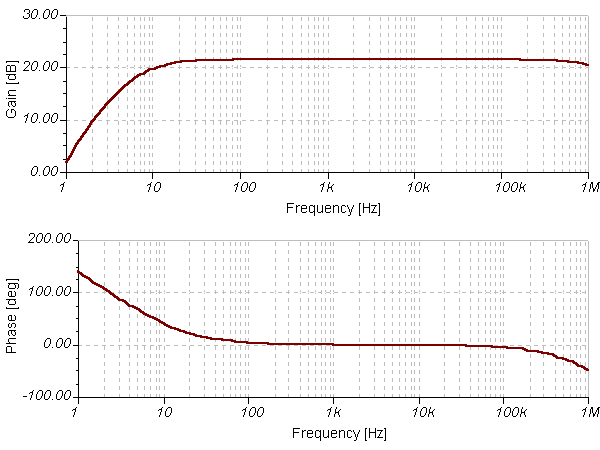
For example, this Bode plot shows that the frequency response is generally flat in the audible spectrum. But the phase isn't flat. There's about 10 degrees of phase shift at 40 Hz, which is right around a bass guitar low E. That 10 degrees at 40 Hz is equivalent to 0.7 ms of delay relative to a 0 degree 40 Hz signal.
Or, thinking of it another way, if you were to sum it with another signal that has 0 deg phase shift at 40 Hz, it's about 10/180 = 0.06 or 6% attenuation at the summed output due to the cancellation.
You can see how this could easily encroach into being audible if the phase shift was worse. You can also see how it's frequency dependent. There's even less phase shift at 55 Hz, i.e. bass guitar open A string.