Maybe it was .1% a year ago? This is an issue in itself - where is the legit carbon accounting?zorg wrote: Tue Dec 21, 2021 6:17 amNever one to excel at maths, but I believe the number is “ 0.1%”, and not “1%.”brownreasontolive wrote: Fri Dec 17, 2021 8:53 am When crypto is approaching a point where it accounts for nearly 1% of carbon emissions, I don't think it can be brushed off so easily.
The One Child Policy was not well recieved, at least in the West, The rite of Carrousel seems like a good option.
I'm having a hard time finding anything that can be properly cited. Depending where you read (articles 2020-now) you'll see 0.1%, 0.3%, 0.9%.
The bulk of information available seems to come from tech and financial journals, which is problematic.
This is already way outdated, but was a good read: https://nrs.harvard.edu/URN-3:HUL.INSTREPOS:37365412
"Under current policy, cryptocurrencies annual carbon footprint by 2028 would
account for approximately 1% of 2018 world’s overall CO2 emissions and associated
high social costs. To maintain positive net benefit for the society, the crypto industry
needs to ensure cryptocurrency price continue rising, faster than energy and social costs
attached to its development. The research results do not suggest that cryptocurrency is
“burning down the planet,” but the negative externalities identified in the research should
be considered. Unlocking blockchain technology potential for the energy sector could be
highly disruptive, considering interesting application in net metering and a transactional
grid, smart contracts, distributed energy resource record keeping, and ownership records,
to name a few (CRS, 2019). This research results suggest that externalities should be
considered by policymakers in order to establish the appropriate guidelines in embracing
blockchain adoption and cryptocurrency’s energy intense processes."
In any case, the energy required to mine bitcoin annually is equal to or greater than that of most European countries.
But then again, the state of California probably consumes double that of Norway. Meanwhile, Lebanon loses power for days at a time in 2021.
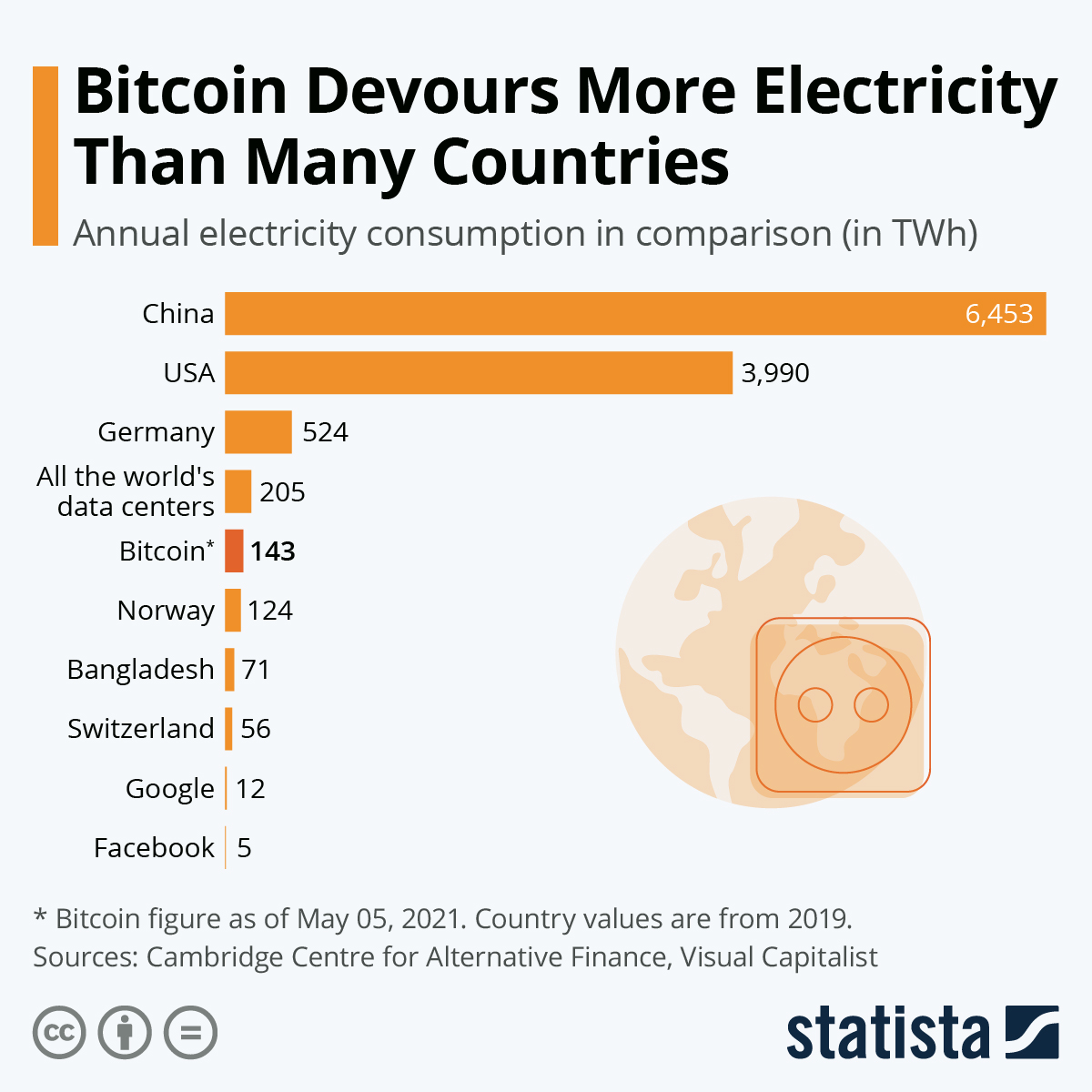
~70% of the crypto generated annually is still consuming TW of energy in places where dirty fossil fuels are the choice fuel source.
Anyway, I don't know what the hell I'm talking about, but I'm very interested in the conversation.
I'd really like to learn more, but maybe from the perspective of actual experts rather than techbros and armchair economists/hobbyist investors?