Re: Small questions that don't fit anywhere

2711
I have a few live rock band recordings from the early 2Ks that are a couple mics at the back of the room and into a mini disc recorder. The sound is not great but I’m wondering what 2025 level technology I could throw at it to improve things. Is this a deal where individual instruments can be separated, processed, and summed back together? What is the Taper Section up to these days with their mixing?
he/him/his

www.bostontypewriterorchestra.com

Re: Small questions that don't fit anywhere

2712
twelvepoint wrote: Tue Nov 25, 2025 9:25 am I have a few live rock band recordings from the early 2Ks that are a couple mics at the back of the room and into a mini disc recorder. The sound is not great but I’m wondering what 2025 level technology I could throw at it to improve things. Is this a deal where individual instruments can be separated, processed, and summed back together? What is the Taper Section up to these days with their mixing?
Steinberg's Spectralayers is on sale for $209 (reg $349) right now and that has some pretty good stem separation. So you can get the individual elements out and remix them TO SOME EXTENT. Depending on the source files, there'll be some bleed between elements (i.e. bits of drums in the guitar tracks), and in my experience if you start putting non-linear stuff (saturation/compression) on some tracks and not others you're gonna have some CRAZEE phasey side effects and be in a world of misery. So tread carefully.

Just remembered you can demo that for 30 days, full functioning, so I'd just grab that and try it out.
work: https://oldcolonymastering.com
fun: https://morespaceecho.com

Re: Small questions that don't fit anywhere

2715
mdc wrote: Tue Nov 25, 2025 2:27 pm If you know anyone who's an ableton user, the newest versions of Live have stem separation built in. Pass the files to a pal and see what it spits out?
FWIW, I recently used Izotopes RX stem separation to "fix" a live mix that had too much bleed in the vocal, and a generally too low vocal in a poorly recorded live recording. I separated the stems and added the Separated vocal back into the bad 2 track mix a little to make the under mixed vocal pop out above the rest of the music. Wasn't perfect but completely saved the recording from being trash. was able to pull the vocal up enough to hear it and even give it a little EQ, Delay and reverb to make it sound a little better. The separated stems sound trach, but when blended back together you don't hear the weirdness as much. Not what most people are doing with Stem Sep. but it is a useful tool for this kinda thing.
Was Japmn.

New OST project: https://japmn.bandcamp.com/album/flight-ost
https://japmn.bandcamp.com/album/numberwitch
https://boneandbell.com/site/music.html

Re: Small questions that don't fit anywhere

2716
Nate Dort wrote: Mon Nov 24, 2025 2:15 pm
TylerDeadPine wrote: Mon Nov 24, 2025 2:00 pm My thought was I would keep the series couples to a minimum and keep on top of how it sounded through each stage.
It's not so much about the number of series caps, as long as they're large enough value. The issue is when you use too small of a value somewhere, which shifts the -3dB cutoff frequency of the low-pass into the audible range. You'll see it in simulation (or on the bench) if you do a Bode plot. One cap can throw it off.

If you're careful about matched bipolar supply rails and use low-offset opamps (or discrete BJTs, in the case of the Mark Levinson stuff) with proper offset and temperature compensation, you can avoid the use of series caps altogether, but it's significantly more expensive and complex to implement that way.

The ML amps I was designing would pass DC from the input to the speakers, so there was a DC offset detection circuit implemented to protect the speakers. You'd be surprised how many songs are released with DC offset present in them. We'd occasionally get complaints that somebody's amp was going into protection mode and would trace it back to a specific song causing the problem.

But on the other hand, the amp had no phase shift from 0 Hz to 50+ kHz, and the frequency response was flat to within 0.1 dB.
Yeah not so much the number = problem, but the number of instances where a decision between filtering & phase impact needed to take place, and management of that. For acoustic guitar there's very specific reasons to be X degrees out
You'd be surprised how many songs are released with DC offset present in them
Yes very! I never ever would have conceived of that

Re: Small questions that don't fit anywhere

2717
Other update: I broke the bass track out to two channels when testing last night and saw that the polarity was flipped. I have to test all my cables and outboard to see which one is flipping the polarity. So, unrelated, but just one mote thing I guess!

Also realized so what if I hear low end when flipping the di/amp tracks - that’s just the difference, right?

Also, to clarify, when checking phase w/ the scope, the A is note was almost perfect and the E note is still in phase but closer to the zero orientation… not necessarily out of phase n
MoreSpaceEcho wrote: Tue Nov 25, 2025 9:08 am
llllllllllllllllllll wrote: Mon Nov 24, 2025 2:49 pm I am wondering if two different forms of compression on the peaks of the two in-phase wave forms of the same performance knocks something out, though, as the two compressors are changing the shape of the top of the in-phase waveforms in different ways. I can see them and I’ll show a picture later when I can get back upstairs.

The other thing is that the release setting of the 610 has an effect of the bass content of the sources (there’s a chart somewhere in a manual I can’t find at the moment), and I wonder if the note being louder on the bass neck (or resonating in the room, whatever’s going on) is triggering something there too.
Compressors compress, they don't go changing the phase of this note or that one. The release on any compressor is going to affect all the frequency content, not just bass, but they're not turning positive waveform excursions into negative ones! If a note is louder it gets compressed more, that's it.
Fair, thanks! I saw the compressor clamping down on the top of the wave form, causing it to move downward where the other track was still going up, so I was wondering if that might do it. I see now the +/- is more important than the slope.

Re: Small questions that don't fit anywhere

2718
llllllllllllllllllll wrote: Tue Nov 25, 2025 5:22 pm Also, to clarify, when checking phase w/ the scope, the A is note was almost perfect and the E note is still in phase but closer to the zero orientation… not necessarily out of phase n
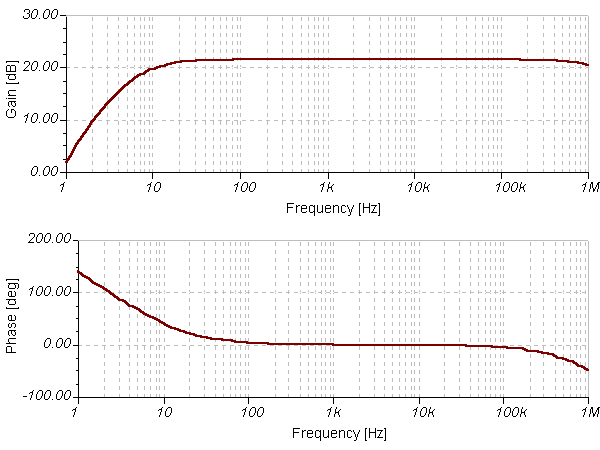
Phase is still the correct terminology here. It's a relative difference in time, measured in degrees. Yeah, in the audio world, people say something is "in phase" or "out of phase" like it's a binary thing, but they usually mean "polarity" in that case, i.e. 180 degrees of phase difference between the signals. You can have two tracks that are a few degrees out of phase with each other, and that phase changes depending on frequency.

Image

For example, this Bode plot shows that the frequency response is generally flat in the audible spectrum. But the phase isn't flat. There's about 10 degrees of phase shift at 40 Hz, which is right around a bass guitar low E. That 10 degrees at 40 Hz is equivalent to 0.7 ms of delay relative to a 0 degree 40 Hz signal.
Or, thinking of it another way, if you were to sum it with another signal that has 0 deg phase shift at 40 Hz, it's about 10/180 = 0.06 or 6% attenuation at the summed output due to the cancellation.
You can see how this could easily encroach into being audible if the phase shift was worse. You can also see how it's frequency dependent. There's even less phase shift at 55 Hz, i.e. bass guitar open A string.
Re: Small questions that don't fit anywhere

2720
b3000 wrote: Wed Nov 26, 2025 9:59 am
b3000 wrote: Mon Nov 24, 2025 5:29 pm Hello. I recently got this good condition 19a9.

Can anyone recommend a step up transformer worthy of this? It’s 220 volt and I am in the US.
Image
Or should I just get one of the switchable AEG power supplies they make?

Someone on here knows the answer to this much better to me, but.....it there any reason a standard-ass step-up transformer wouldnt work for this?

https://www.amazon.com/Yinleader-Voltag ... ref=sr_1_3
Website: http://ballseffects.com/
Instagram: https://www.instagram.com/thetonyballs/

Who is online

Users browsing this forum: No registered users and 1 guest